
Office design and build
Design and build puts design and construction under one contract, with one party responsible for both. Done well, it is quicker and gives more certainty on cost. Done badly, it hands control of quality to the contractor. The difference lies in the brief and the contract.
In a traditional route, you appoint a designer and then tender the build to contractors. In design and build, the contractor takes on the design, or develops yours, and delivers it for an agreed price. Overlapping design and construction can shorten the programme, and if something goes wrong there is one party responsible for putting it right.
Business Interiors delivered many projects this way, with designers and project managers working side by side: from the group head office of Cotswold Inns and Hotels in Evesham to the reception, canteen and data centre of South West Communications in Exeter.
How it runs
A design and build project, start to finish
Brief and budget
A clear brief and a realistic budget agreed at the start, because changes after the price is fixed cost more.
Design development
Layouts, finishes and services designed and priced together, so cost is checked as the design develops.
Price and programme
A contract sum and programme agreed before work starts on site, with clear allowances for anything still unknown.
Delivery and handover
Construction, furniture installation and commissioning, then a snagging period and the documents you need to run the space.
What to get right
Protect quality when the contractor holds the pen
Design and build works best when your requirements are written down clearly. Vague requirements leave room for cheaper substitutes and simplified details.
If you want more control, have the design developed to an agreed stage before the contractor takes it on, or keep an independent adviser to review the contractor’s proposals on your behalf.
- Specify performance as well as appearance: acoustics, lighting levels and fresh air.
- Agree how changes will be priced before work starts.
- Insist on a realistic programme with time for furniture, IT and commissioning.
- Collect operation and maintenance information and warranties at handover.
A good fit if…
- Programme and cost certainty matter more to you than controlling every detail.
- You want one contract and one party responsible.
- The building and the brief are reasonably straightforward.
Probably not the right fit if…
- You want to test the market on a fully detailed design. Consider design first, then a competitive tender.
From the archive
South West Communications
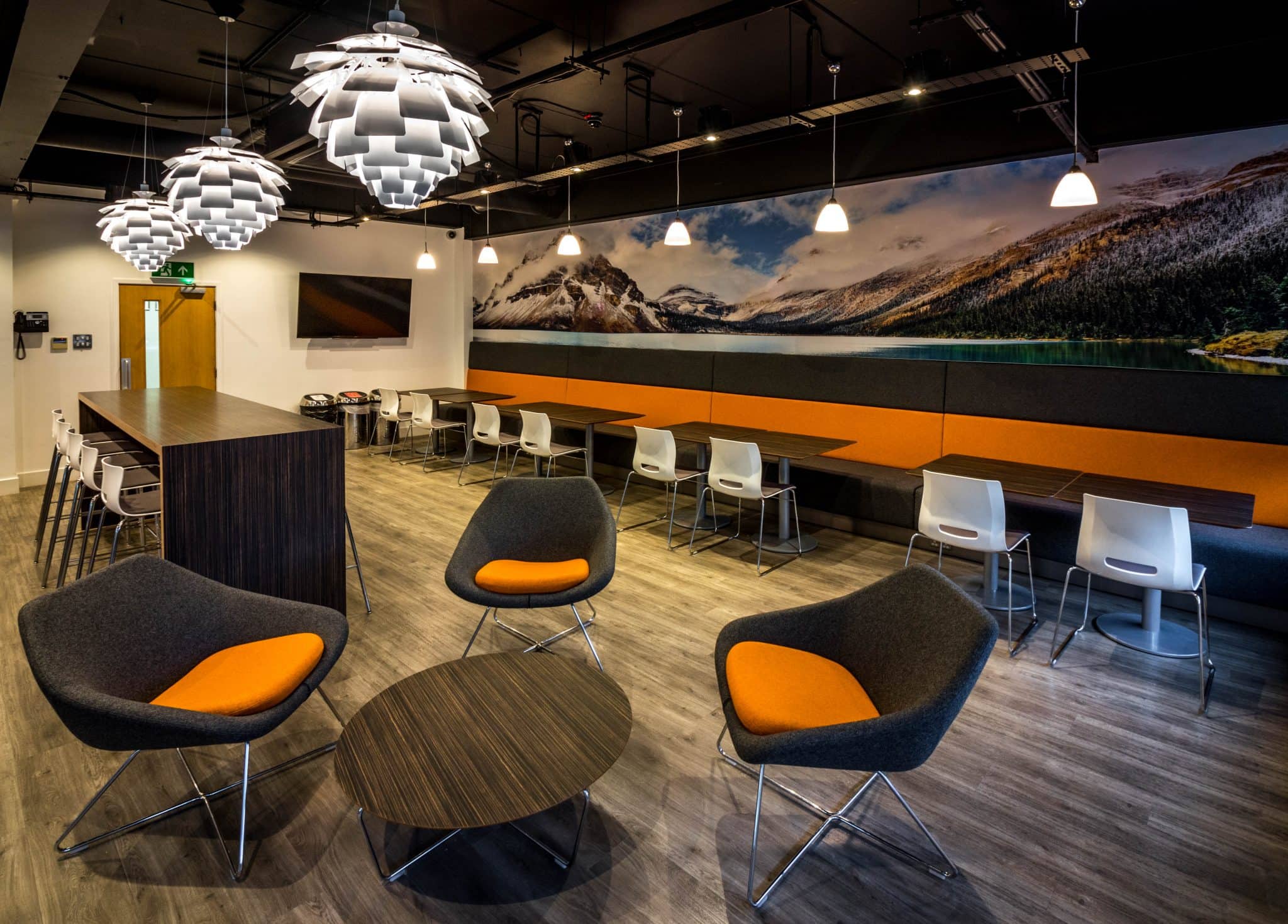
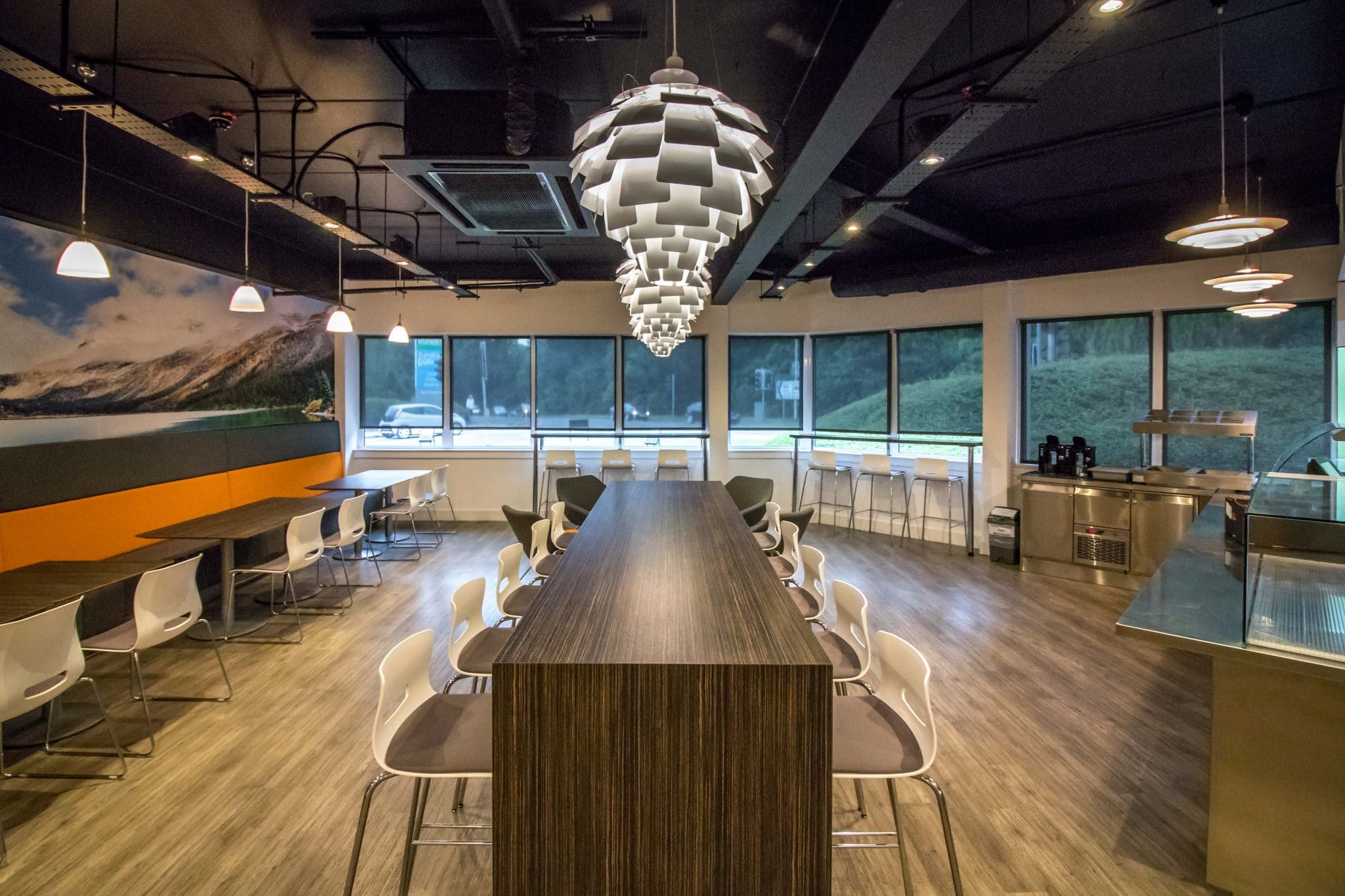
To refresh an ageing reception, staff canteen and data centre in Exeter, the canteen’s false ceiling came out entirely, giving a taller, more industrial space with exposed services and a long bench to make the most of the room.
Questions
What clients usually ask
Is design and build cheaper?
Not automatically. It can save time and fees, and gives you an agreed price earlier. But the price only covers what is in the requirements, so a thin brief can lead to extras or a lower standard than you expected.
What do Cat A and Cat B mean?
Cat A is the landlord’s basic finished space: typically raised floors, suspended ceilings, lighting and air conditioning. Cat B is the occupier’s fit-out on top: partitions, kitchens, meeting rooms, furniture and finishes. Exactly what is included varies from building to building.
How long does an office fit-out take?
It depends on size and complexity. Allow time for design and pricing, then the works on site, plus lead times for furniture, IT and equipment, which can run to several weeks.
Related
Where this leads
Office interior design · Designing before you build
Office refurbishment · Improving the office you have
Office relocation · Moving to new space
Start a conversation
Planning a move, a refurbishment or a rethink?
Tell us about the space, the people who use it and the date you are working to. You will get a straight answer about what it needs, what it is likely to cost and what to do first.