
Why the most successful businesses of tomorrow might employ fewer people, operate with hundreds of invisible workers and need better offices than ever before.
Once upon a time, you could walk into a company’s offices and learn quite a lot about the business. The number of people milling around gave you an indication of its size. The quality of the furniture, architecture and finishes suggested something about its profitability. The layout told you whether the organisation was progressive, collaborative and forward-thinking, or still operating in the past. A large, impressive headquarters was a statement of success.
But walk into that same headquarters today and you might find yourself asking a rather different question. Has this business noticed the tsunami? Not the one that’s coming. The one that’s already arrived.
Artificial intelligence is beginning to change the economics of business so profoundly that some of our most basic assumptions about organisations – how many people they need, how they are managed and where they work – may no longer hold. And the office, perhaps more than anything else, is about to reveal which businesses understand that change.
The workforce you can’t see
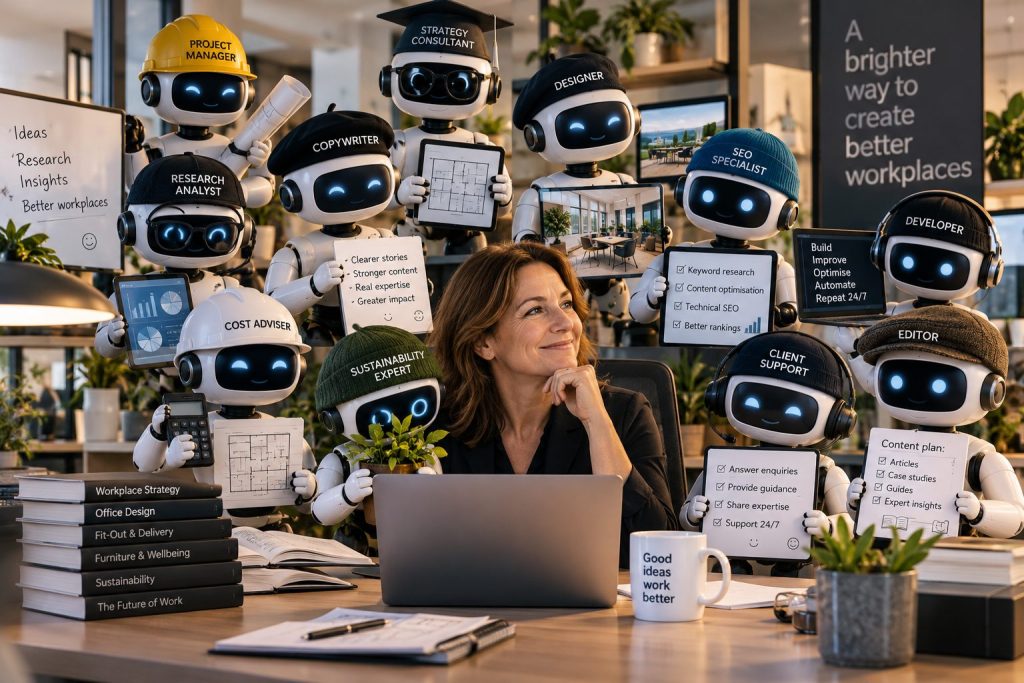
Imagine two companies. The first employs 100 people. It has departments for finance, marketing, administration, research, sales and management. It occupies a substantial office, with all the associated costs. The second employs ten people, but behind each of those ten sits an increasingly capable team of AI agents: researchers, analysts, designers, administrators, financial advisers, marketing specialists and project coordinators. They work around the clock, can be deployed almost instantly and can be scaled up or down as required. They don’t need desks, they don’t commute and they don’t need meeting rooms, kitchens or parking spaces.
The second company might have the productive capacity of an organisation many times its physical size. Of course, AI agents aren’t literally employees. They still make mistakes, need supervision and cannot simply take responsibility for every task. Nor is the arrival of genuinely superintelligent systems a settled fact. But the direction is becoming difficult to ignore. The number of people you can see is no longer a reliable measure of what a business can do, and that changes everything.
The number of people you can see is no longer a reliable measure of what a business can do.
Small businesses have always enjoyed certain advantages. They can make decisions quickly, they are close to their customers and they don’t need committees to approve every idea. Large businesses have traditionally compensated with scale: greater resources, specialist departments, financial strength, established relationships and powerful brands. AI threatens to alter that balance, because many of the capabilities that once required substantial organisational infrastructure are becoming available to individuals and very small teams.
A talented salesperson, for example, might once have depended on an entire supporting organisation to research prospects, prepare quotations, produce presentations, analyse costs and coordinate delivery. Now imagine that same salesperson with an extraordinarily capable virtual team. As their business grows, more resources can flow behind them without the same increase in permanent overhead. In effect, the salesperson becomes the managing director of a small business operating within a larger one. A company employing 100 salespeople might therefore be better understood as 100 entrepreneurial businesses sharing a brand, reputation, capital and infrastructure.
The challenge for management is no longer simply to supervise those people. It is to create the conditions in which each of them can become exceptionally productive. Perhaps the answer for large organisations isn’t to become smaller, but to become collections of smaller businesses: small, accountable teams, empowered to make decisions, supported by shared resources and connected to a common intelligence. The centre still matters. It provides direction, financial discipline, governance and the collective strength of the brand. But knowledge and resources flow in both directions, without every decision having to climb a management hierarchy and come back down again.
A commercial battle at the speed of light
There is a temptation to see AI mainly as an opportunity to increase profitability. If a business can produce the same output with fewer resources, surely its margins will improve. At first, perhaps. But competition has an inconvenient habit of passing the benefits of innovation on to customers. When one business can deliver something faster and more cheaply, others must respond. Prices come under pressure, expectations rise and what was an extraordinary capability yesterday becomes the minimum requirement tomorrow.
This is how business has always worked. The difference is speed. In the past, a competitor’s advantage might take years to establish through new factories, new processes, new markets or new skills. Today, a significant advance in AI can change the economics of a business process with a software update. The time available to recognise change and respond to it is shrinking. This is becoming a commercial battle at the speed of light, and you cannot fight it with an organisational structure that takes six months to make a decision.
The businesses that succeed won’t necessarily be those with the most AI. They’ll be those that can turn new intelligence into better decisions and decisive action. That still requires people, but perhaps not the same number of people, doing the same jobs, in the same hierarchy.
For generations, knowledge helped determine someone’s position within an organisation. Qualifications, technical expertise and decades of accumulated experience were valuable partly because that knowledge was hard to acquire. The more you knew, the more others depended on you. Now imagine an ambitious 25-year-old with exceptional energy, intuition and emotional intelligence, supported by AI that can give specialist advice across an enormous range of subjects. That person may be able to make better-informed decisions, more quickly, than someone who relies solely on experience accumulated over 30 years.
Experience still matters enormously. So does the ability to recognise poor advice, understand context and take responsibility when things go wrong. But knowledge is becoming less scarce. As it becomes more widely accessible, other qualities become more important: judgement, initiative, adaptability, leadership, trust and the ability to understand people and bring them together. The brilliant employee of tomorrow may not be the person who knows the most. It may be the person who can do the most with what everyone can now know.
What is the office actually for?
For many office-based businesses, two of their largest costs are people and property. AI has the potential to transform the economics of both. If fewer people can produce more, businesses may need less physical space. If administrative and analytical tasks can be done virtually, the traditional relationship between headcount and floor area begins to break down.
For the office interiors industry, that is an uncomfortable thought. We have spent decades helping organisations accommodate their people efficiently, attractively and productively. But what happens when the workforce becomes partly invisible? Do we carry on designing offices around headcount and treating the number of desks as the starting point? Or do we ask a more fundamental question about what the office is actually for?
Agile and remote working promised to liberate people from the office, and in many respects they succeeded. People discovered they could work effectively from home, avoid commuting and concentrate without the interruptions of a busy workplace. Those benefits are real and they aren’t going away. But something else happened. The informal transfer of knowledge between generations weakened. The young employee could no longer absorb the experience of older colleagues simply by sitting alongside them. Relationships became harder to build, chance encounters disappeared and people became less visible to those making decisions about opportunities and progression.
The old saying still has force: out of sight, out of mind.
Now AI adds an unexpected twist. The young employee who comes into the office, builds relationships and develops commercial instincts may also have an AI copilot that supplies much of the technical knowledge that once took years to accumulate. They are no longer necessarily waiting for the experienced colleague to teach them everything. They can arrive informed, prepared and ready to act.
And if that experienced colleague stays isolated, relying on yesterday’s expertise rather than embracing new tools and relationships, the advantage may reverse. This isn’t really about age. An experienced professional who embraces AI could be exceptionally effective. It’s about participation, adaptability and visibility. AI may make it easier than ever to work anywhere, while making it more important than ever to be somewhere. Not because every task requires an office, but because careers, businesses and opportunities are built through human relationships as well as individual output.
AI may make it easier than ever to work anywhere, while making it more important than ever to be somewhere.
Here is the paradox. If AI allows businesses to operate with fewer people, we might reasonably expect offices to become less important. But perhaps the opposite is true. When intelligence is widely available, what becomes valuable is the ability to bring people together and turn that intelligence into something meaningful. Trust, collaboration, leadership, persuasion, shared ambition and a sense of belonging are not simply by-products of work. They are among the things that make organisations successful.
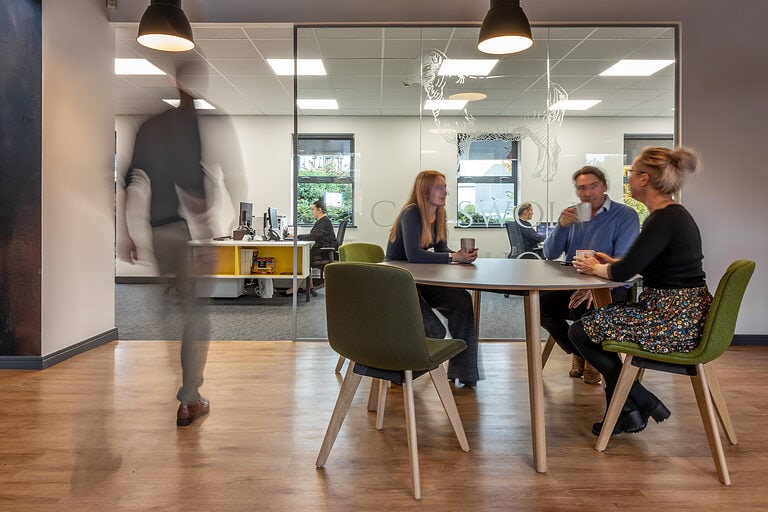
The office of the future may therefore need fewer conventional workstations but considerably better environments for human interaction. Spaces where people want to spend time. Places for conversation, collaboration, learning and the unexpected encounters from which ideas emerge. Environments that make people feel part of something worthwhile. Some work will always be better done quietly at home. The office doesn’t need to win every hour of every working day, but it should offer something that home working cannot easily replicate.
The objective shouldn’t be to force people back to their desks. It should be to create workplaces that people recognise are worth coming back to.
Fewer desks. Better offices.
For a long time, the office was where an organisation housed its workforce. Increasingly, that workforce may be split between a relatively small number of people and a much larger collection of virtual capabilities. The physical office can no longer be justified simply by counting employees and allocating desks. It must justify itself through the value it creates when people come together.
That is both a challenge and an opportunity, for businesses and for those of us who design their workplaces. The great office of tomorrow may be smaller than its predecessor. It may hold fewer people and look nothing like the headquarters we once associated with success. But it could be a much better place to work.
Because while artificial intelligence may transform what individuals can achieve, the best businesses will still understand how to make people achieve more together.
We may need fewer desks than ever before. But we may need better offices than ever before.
And the next time you walk into an impressive headquarters, perhaps the question won’t be how many people work there. It will be how much value the people who are there create, together with all the intelligence you cannot see.